Tuesday, August 13, 2013

Tengani: Keep the Last Florescent Light Burning

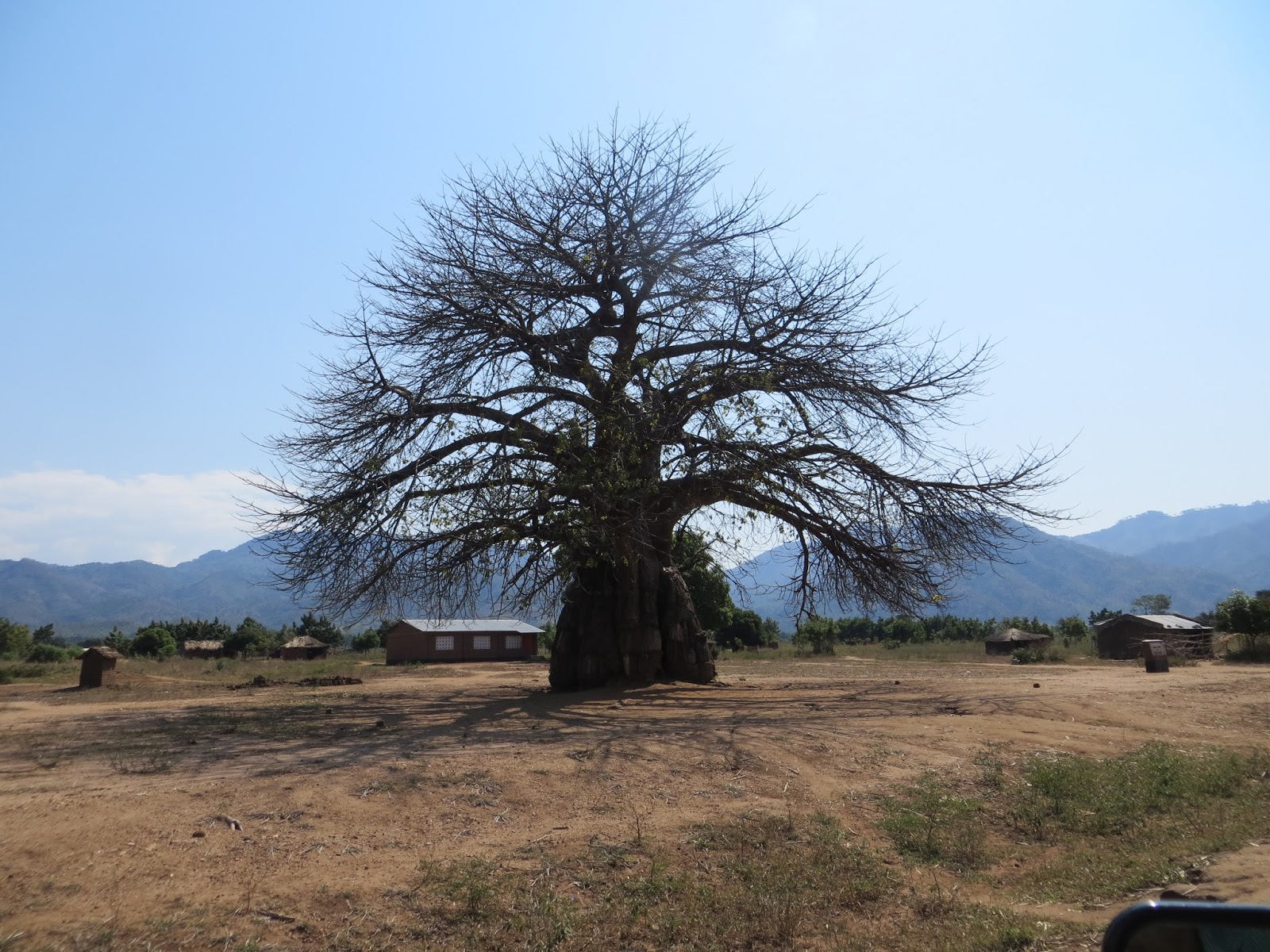
          My team went to Tengani, about half an hour north of here. We passed through grasslands with scattered tall trees fortunate enough to escape being chopped down for firewood, the rest were tiny bushes which suffered periodic chopping and never were able to grow any bigger.  The mango trees fared better since they bore fruits that could bring in some cash although they too suffered some amount of slashing. The baobab trees with their thick trunks challenged anyone to put an axe to chop them down.  They were attacked only when the hollow ones fell during a storm and the locals had a slow burn of the trunks to make charcoal for sale.  

          About a hundred meters from the tarmac road ran the defunct railway track.  This track started from Lilongwe, the capital all the way south to Mozambique.  The driver said trains used to travel from Limbe to Nsanje but two years ago it stopped because the Shire River flooded and destroyed the track.  Over a dry riverbed part of the track floated in the air with all its trestles washed away.  A vandalized train station with no roof and broken and mildewed walls stood forlornly by the track.  It looked as though it must have been more than two years since the train stopped running.  The driver assured me that “they” were ready to fix the tracks soon...I took this in with a large grain of salt.
          In the hot sun some villagers sat or stood by the road sides selling small amounts of produce; a few papayas, a cluster of tomatoes; on the opposite side of the road, someone just left a small basin of beans with a scooper for sale to passing buyers.  Vehicles were few and far between, one wondered how many kwachas were they able to collect selling such small quantities of goods.
           At the sign of Tengani we turned off from the tarmac to a dirt road and soon passed a cluster of buildings marked Nsanje District, Agriculture Office, Resource Center.  The windows and doors were broken, some windows were just literally ripped off the buildings; it was obvious that no one worked there anymore.  In the afternoon when we passed by again, a truck had just delivered forty to fifty sacks of something stacked neatly on the veranda of one of the buildings.

          Tengani Health Center was in an enclosed compound. One huge chunk of the eaves was missing and another hanging precariously from the roof, it was only prevented from falling off by a vertical drainpipe and another hanging precariously from the roof.  There were two rows of buildings.  One housed the Men and Women Wards which were no longer working as wards, outpatient Department (OPD), the antenatal clinic and then the Maternity Ward which was divided into the Antenatal, Labor and Delivery and the Postnatal Wards.   A broken roof beam in the OPD was splinted together with metal bars from parts of a wheelchair and dangled dangerously over where the patients sat. 
Tengani Health Center

           The six rusty beds in the Antenatal Ward were without mattresses, the mid-wife told us they no longer used it.   On the floor was a sterilizer looking somewhat abandoned but it was actually used for sterilizing instruments.  There were six pairs of florescent light fixtures but only one lamp left, some fixtures had wires hanging out.  When the lamp from the other wards burned out, the lamps from the Antenatal Ward were systematically stripped leaving it with its last lamp.  The counter of the two sinks in the Labor and Delivery room was cluttered with a baby scale, rags, basins, and used instruments.  It had two beds and it did not look like it was ready for the next birth.  On the wall of one of the cabinets was a hand-written note on “How to Deliver a Baby”, there was a notation about providing a clean, warm and well-lit space for the newborn…The postnatal Ward had four beds with mattresses and bed nets.  The floor was sparklingly clean and there was no bad odor.
The Antenatal Ward

          The mid-wife in the antenatal clinic dragged out the one-year-old brand-new unused sterilizer from the storage room which was dark as there was no light bulb in there.  The sterilizer had a plug that did not fit the wall socket and so it was put back in the box and stored.  Already the hands on the temperature gauge were broken.
          Her crowded exam room had a florescent light which did not work.  She used a water tank with a spigot for hand washing.  When I asked her whether things had improved or deteriorated for the three years she had been there, she paused and said, “Things have been changing.”
            “Are they changing for the better or for the worse?”
            “It’s better.”
            “In what ways?”
            She paused again and answered, “We didn’t used to have mattresses on the beds.  A local politician bought mattresses for the Postnatal Ward and the Labor and Delivery Room.  The women are more comfortable now.”
            “But you don’t have mattresses for the Antenatal Ward.”
            “We don’t use it.”

           Apparently a request had been made for more florescent lights but this had been on hold because of a plan to eventually switch to energy saving light bulbs.

           I asked, “What happened when your last light went out?”
            “We ask the patient’s guardian to bring candles.”
            “You deliver by candle light then?”
            She laughed.  I peered at this patient, long-suffering nurse who worked under such distressed condition and yet survived each day on the last leg of a florescent lamp.

          A national commented, “Maintenance is a big problem.”  This is not unique to Malawi, it is a common and chronic problem in Africa. He continued,” It will drain the whole budget of the district if funds are given to maintain this place.”
          We observed the mid-wife taking meticulous care of each and every one of her pregnant woman, unhurried even way past the lunch hour.  Mozambique is to the east of Tengani, Mozambicans cross the Shire River in dugout canoes and walk about 5 km to the health center. Here the Sena people live in Malawi and Mozambique and they speak a mixture of Chichewa and Sena. The boundary between the two countries blurs.
            
Outside the mid-wife’s room her patients sat on a bench, on the floor or lay on chitenjes (wraps) waiting patiently for their turns to see her.  Every single one of them had been tested for HIV. In any country patients would be up in arms to have to wait so long to see a doctor.  Here in Africa waiting for a long time is the norm. 


Sunday, August 11, 2013

Happy Birthday to Cara from Malawi

          It has been a very quiet three-day weekend for me, relaxing and not yet swarming with work like the other ladies who seem to be working constantly on their computers after work and on weekends.  Perhaps work will catch up with me the longer I am here: long tedious and painful meetings with minutes that span numerous pages, countless reports, data collection, deadlines…

          Today is a special day for Cara, my daughter who is also a talented artist.  She denounced society for the month of July to be at a silent meditation retreat so we did not get to say good-bye in person when I left.  A year ago she did a three-month long silent retreat; I mean no talking to any participant even the person whom she shared chores with!
          My children think their mom is “crazy” but they probably inherit a bit of the trait.  A few years ago she and a bunch of kids biked across the States from Providence, Rhode Island to Seattle for Bike and Build, raising funds and awareness for affordable housing and building houses with Habitat for Humanity along the way.  Last year she and I took a mother and daughter trip to South-East Asia and climbed the highest mountain: Mt. Kinabalu in Sabah, North Borneo.  This year she ran barefoot the last six miles of the Boston Marathon taking her shoes off at Heartbreak Hill.  I sent her a clip on Abebe Bikila, the Ethiopian marathon runner who conquered the 1960 Rome Olympics barefoot.
Cara and I at Mt. Kinabalu

Cara Running Barefoot with Charles Dressed as Faries at Bottom of Heartbreak Hill

          One winter while she was running barefoot in the snow, a garbage man asked her,” Hey lady, you forgot something?”

The next time she ran with her shoes, he said,” I see you got shoes for Christmas.”

Before I departed for Malawi, I left a picture of her when she was at the Lexington Montessori School for her birthday.  She has come a long way since then.

Happy Birthday, Cara! 
Cara at Lexington Montessori School

Cara and I at our Belmont Home


Friday, August 9, 2013

Eid-Al-Fatr

       
The New Moon and the Star

          We had a day off for the end of Ramadan, Eid-Al-Fatr, the actual date was determined by the observation of the new moon by local religious authorities.
          I celebrated my day-off by doing a long run of 7 miles, twice the distance I have been running recently to see whether I had the stamina to do so a few months after my illness; from Nsanje to Chididi back and forth twice. A bunch of women with festive and colorful wrappers saw me on other days must have thought it strange for someone to run on a hot day and three of them spontaneously ran to me with open arms and big smiles and gave me a bear hug.

          Here there was no celebration for the end of Ramadan as this region is mostly Christians or Animists.  On Eid-Al-Fatr of 2011, I went to Kano, Nigeria, a Muslim region alone not knowing that a travel advisory was just released by the State Department advising US citizens not to travel to the north of Nigeria.  There was a raid by the Boko Haram, Islamist extremists of Nigeria freeing some prisoners at a Bauchi police station in the north a few days before. Tension was also running high because of a threat by a Florida pastor to burn the Koran and BBC and CNN ran this piece of news constantly.  I thought I could always use my cover as a Malaysia and moreover many times in Africa, besides being called Muzungu, I have been greeted with “Konichiwa!”.  In the end  I spent three peaceful days without incidents exploring Kano and was able to witness the Durbar, a spectacular horse parade at the Emir’s Pavilion at his Palace.

At the Durbar in Kano, Nigeria

A Proud Horseman in Kano

          The local mountains beckoned but I could find no information about how to get to them or how safe it was to climb.  Someone did give some vague directions but as I ran towards the way he indicated one day only to wind up in a village with such meandering dirt paths that I was afraid to lose my way.  He did “promise” to come on a weekend day to hike but as always I did not take it seriously and did my own thing knowing that it was really a nebulous “maybe”.  So no hiking for me at least for the moment.

          Here darkness fell quite quickly and without much warning, the whole village was plunged into a dark void.  I did not see any house with electricity but Shire House was brightly lit with porch lights all night making it difficult for me to enjoy the Milky Way.  As dusk came the bats living in the rafters of the house flapped their wings and flew in groups into the evening sky ready to begin their nocturnal hunting.  Roger our guard dog was finally allowed to come out for the night.


Roger


Dusk


Thursday, August 8, 2013

Ndamera

          Today I traveled to Ndamera with a group of MSF staffers including my MSF mentors and a Ministry of Health (MOH) mentor.  This was my first field day.  Half of Malawi is engulfed by Mozambique in the southern region.  Ndamera and Lulwe are two regions that are southernmost of Nsanje.  As soon as we left Nsanje town the tarmac road disappeared to be followed by compact dirt road, bumpy at times and crossing several dry riverbeds.  Many of the bridges seemed to have sunk into the beds. There were scattered red-brick or stucco houses with tin or thatch roofing.  After about fifteen minutes we reached Mbenji Health Facility and dropped off a few staff.  The center of town had a short tarmac road, narrow to begin with thin slivers of dirt sidewalks which were all occupied with sellers of produce, tomatoes, sweet potatoes, second-hand clothing mainly from America or kaunjika, new clothes of different African football teams and European teams, all spilling into the sides of the road, making the road even narrower.  This reminded me of Freetown in Sierra Leone or La Paz in Bolivia where the sidewalks were taken by the vendors and pedestrians spilled into the main roadway running the danger of being run over by vehicles.


Vendors at Mbenji

          We were besieged by a herd of cows which looked a little bewildered trying to maneuver around the cruiser.  Their big wide and innocent eyes looked around patiently.  The land is dry but not as dry as in South Sudan, they could still find some meager pickings in the lowlands.

          We passed by a defunct railway track, the driver who is from this region could not tell me when it was last functioning. The land is overgrown with weeds, I could discern no crops at least from the road.  I was told tomatoes are grown in the hills.  Mango trees are bearing small fruits now and soon we will be able to have mangoes.  Naked baobab trees look prominent among trees that are all green with leaves.
          Ndamera Health Center was funded by UNHCR, I could not ascertain when it was built.  It looks old and decrepit.  Two taps have labels next to them stating they are not functional, one is bone dry and the other drips and is tied with rubber tubing to try in vain to stop the drip.  The maternity section is on one side with antenatal, labor and delivery and postnatal care units.  The outpatient department is in the center and the HIV counseling room and other unusable rooms on the other side. At the back is a huge tent which was set up a couple of years ago for the cholera outbreak which happens periodically when the river floods. 

Ndamera Health Center

Cholera Tent at Ndamera

          The HIV treatment room is in a new building with many rooms but only one large room is being used to see patients and an adjoining room to register, weigh and give patients their master patient card.  Outside there is a waiting room.  On the day we visited there were a medical assistant and a nurse seeing the patients.  Most of the patients were women and babies, only a few men attended the clinic.  Mozambique being only 5 Km away, most patients came from there.  They were dressed quite warmly from head to ankles and most did not wear shoes.  I wonder how their feet feel where the temperature soars.
          
          As we drove towards the town of Nsanje in the early afternoon, the mountains in the distance looked hazy and hot.  The baobab tree looked fried but still dignified in its naked state.

The Pregnant Baobab Tree

Wednesday, August 7, 2013

Food Insecurity

          A headline in the July 31st issue of the newspaper “The Nation” ominously announces: Food Insecurity to Rise in Malawi.  The population growth in Malawi which is predicted to be at 3.3% per year over the next decade, 2013 to 2023 compared to that of the rest of the Sub-Saharan Africa of 2.8%, poses a threat to food insecurity.  Indeed even now it is said that World Food Program (WFP) should be providing food for Malawians before the situation becomes worse.  The three countries that are predicted to have the most significant deterioration in food insecurity are Malawi, Uganda and Chad.  Other countries such as Central African Republic, DRC, Burundi, Eritrea, Somalia and Zambia are not far behind.  I spoke to a native here who testified to the fact that for at least the last thirty years, he could not remember a year in which any form of food distribution was not given to Nsanje district. 

          I have been to Africa so many times and still cannot understand why so many of the countries in the continent are always in perpetual need of foreign aids.  Relief agencies have been in Africa for years and yet poverty, hunger, famine, lack of water and sanitation, education, healthcare persist; the agencies do not seem to be able to make a dent in these confounding problems plaguing Africa despite tons of money being poured into Africa.  Some Africans think aids agencies are the problem and that they trigger the cycle of dependence.  However without them many of the impoverished inhabitants of countries and regions that have been forgotten by the government will be left to suffer.  I remember seeing a map of the areas around Dadaab in Kenya completely taken over by different relief agencies, the government takes no interest in providing any services for the people there.  A cynic would argue that the government has no reason to provide care as their own people would be taken care of by relief agencies, there lies the argument for the cycle of dependency.  If on the other hand relief agencies pulled out now the whole fabric of the African society that depends on them would collapse. 

         An election outcome of an African nation has virtually no impact on the lives of the people in the remote areas as the leaders themselves have totally neglected them for years.  Corruption may be partly to blame for the lack of progress in many of the African nations, many leaders are mainly interested in enriching themselves and their cronies and to contrive to stay in power for as long as they can to continue to benefit from their ill-gotten gains.  A few years ago the Kenyan parliament voted to tax the MPs, apparently unlike the regular citizens, MPs were exempt from paying taxes and when it came close to the time when they had to pay their due, they voted against having taxes levied on them. They enjoyed a lot of perks as politicians and yet to shoulder a fair share of the tax burden was distasteful to them.  Was it greed that drove them against being taxed?  On my second visit to Kampala, the roads were just as bad as the first time I went there.  I commented to a Ugandan that if I were the President of Uganda and had been in power for such a long time I would be ashamed of the poor conditions of the roads.  His said facetiously that the president would reply that he did not have the money to improve them and would need some foreign aid. 

           Food insecurity in Malawi has been a perpetual problem due to drought and flooding. The flat area in Nasanje is prone to flooding by the Shire River during the rainy season. I am not an engineer but I wonder why a more permanent solution has not been sought such as an irrigation system and some kind of flood control.  From what I could see in the countryside, there is no large scale agriculture here and the people still stick to subsistence farming for their day-to-day survival.  If their crop fails they have no other recourse but to hope for foreign food distribution.

          The other evening in my run I was pestered by a few kids yelling,”Muzungu. give me money!” I am not a European white but just the same I am a foreigner to them and foreigners have the money. Just about the only place I seldom hear kids asking for money was when I was deep in the bush of South Sudan.  In Ethiopia the kids put out their palms asking for Birr, they thought it was hilarious when I in turn put out mine and asked them for Birr.  My traveling companion yelled at them, “Yellem!”  in Amharic (We have nothing).  Here I said, “You have to work for it.”  Later I learned a few words of Chichewa: Ndilibe ndalama (I have no money) or Maluzi (I am broke) to arm myself against such verbal assaults. That evening however I decided to sprint and left the pestering kids in the dust.

Tuesday, August 6, 2013

HIV/AIDS in Nsanje

          Malawi is a landlocked narrow country bordered on the western side by Lake Malawi.  It is the most resource-limited country in southern Africa and is the most densely populated in the whole of Africa with a fertility rate of 5.7 per female.  It has the highest HIV prevalence with the national rate of 10.6% and the lowest health worker population ratio of one doctor to 88,000 people.  Life expectancy is among one of the lowest in the world, is just 41 years because of HIV/AIDS, malaria and tuberculosis and lack of healthcare system.

          The population of Malawi is at 15 million with 40% of the population lives below poverty level and over 85% are subsistence farmers in the rural areas.  Foreign aid including IMF and the World Bank and from countries like USA, Britain and Germany constitutes about 40% of the entire government budget and pays the bills for over 90% of its investment and development projects.  An economy that depends on subsistence farming and some exportable cash crops will find it difficult to be rid of foreign aid dependency.
          In healthcare, donors contributed at least 60% of the expenditure during the 2006 to 2009 cycle.  One of the more acute problems is the persistent shortage of healthcare workers.  The country is operating on 33% of the required healthcare workers as stipulated by WHO and of those only 35% of them serve in the rural areas where 80% of the population reside.  global funds provide 100% of the HIV medications.
          The seroprevalence of HIV in the nation varies between 10.6 to 12% but there are regional differences with the most populated southern region where Nsanje is having a prevalence of 16 to 18% in 2010 with 65% of the newly infected being recorded there.  The main mode of transmission is through heterosexual sex followed by mother-to-child transmission.
          MSF has been in Malawi since 1997 with the aim to reduce the morbidity and mortality of HIV and TB and in 2003, it started treatment of HIV/AIDS and its associated infections in Thyolo.  Since 2011 MSF began to be involved in Nsanje in the support of the Ministry of Health in a mentorship program in the provision of quality HIV care and also introduced targeted health system such as test and treat sero-discordant couples, sex workers, non-surgical male circumcision, treatment of all HIV positive pregnant women and integration of HIV/TB services.  My main role will be in the mentorship program and to help with the integration of other services.


Monday, August 5, 2013

Nsanje

          Nsanje is at the tip of Malawi at its southernmost region, remote and isolated and the lowest point is 200 meters above sea level which explains the hot and humid weather and temperature could top 45 degrees Centigrade in October and November. Just days before I left, a neighbor told me that I should read “The Lower River” by Paul Theroux, a novel about a former Peace Corps volunteer going back to close to this area hoping to relive his happy times forty years ago, only to be greatly disappointed seeing the crumbling structures including the school he helped to build and by the lack of progress in this region.  Almost all the people he knew had died and the inhabitants could not care less about education; were manipulative, almost hostile to him and were more interested in fleecing him.  He also described the hot and uncomfortably humid days that blended together making him listless and helpless and he was unable to rescue himself from sinking further into a morose state. It was so despairingly dark that I regretted having read it just before I left, wondering what I had gotten myself into.  

          In his “Dark Star Safari” Paul Theroux described Nsanje “Once known as Port Herald, Nsanje was so buggy and malarial it had been Malawi’s Siberia for decades, a penal colony for political dissidents.  Undesirables were sent to the southern region to rot”! 
          The Shire House where we live nestles deep in the village looking plush and incongruous compared to the smaller houses in the bush. MSF recently helped the owner to build it and would maintain it and use it rent -free for the next three years.  There is a screened front porch with rattan chairs to lounge in, a large living room, a dining room and a kitchen with a spacious pantry.  From the screened porch at the back, one could see mountains in the distance. The house is very spacious with six bedrooms; all have en-suite bathrooms except three, one of which is mine as I am the last one of the team to arrive.  We are two doctors, a nurse, a health promoter, a laboratory person, and a logistician.  It is an all women and international team; Australia, Belgium, Philippines and USA.
Shire House

          The most wonderful thing is, there is a kitten here and she just arrived the week before me from Blantyre, playful and cute and will certainly make this place feel like a home. She is to catch the mice in the house and for now she is just chasing them around or is scared by them; they are half her size. My first night in Shire House she decided to spend the entire night with me, snuggling and occasionally getting up nibbling on my earrings, necklace and bangle and since then she has chosen to sleep with me. A few names have been floated around, Scruffy, Mimi, Engine.  I gave her a Chichewa name: Kuyvina which means to dance and she seems to do a lot of that being quite frisky.  And so her name is Kuyvina. Roger the young black dog is our security dog but his situation is appalling, cooped up all day and at night he is let out but tied to a short leash by the gate; no time to run around and be free.


Me and the Kitten  in Shire House


Kuyvina


At the MSF office, I had a few days of briefings.  There is so much information given to me and so many new faces and names that I am completely overwhelmed and saturated.  My role here is as a MD mentor in HIV/AIDS for 14 health Facilities in Nsanje working in conjunction with the Ministry Office of Health (MOH).

Over the weekend I took a three hour walk into the town, people are mostly friendly whenever they are greeted: Mulibwanji (hello, or how are you), didikwano (I am fine), zikomo Kwambiri (thank you very much).  There is a church at the entrance to our village which I was told has been under construction for roughly twenty years but runs out of funds apparently someone has siphoned a large amount of the funding.  It looks quite grandiose for Nsanje, almost a cathedral.
Nsanje Cathedral

Market day is Wednesday so there were few sellers of tomatoes, roasted ears of corn, fried pork and little shops selling soda, chips, sweets salt, pepper, sugar lotions…A bicycle tire-repair man set up his shop by a baobab tree.  I found my way to the Shire River, young men congregated on the graveled beach howling at me to come and take their pictures.  A couple of them went to a more secluded area to bath, soaping their glistening naked black bodies and dipping into the water to wash.  Later I learned that there are many crocs and hippos in the river. This is the Shire Port, there were three boats there which looked more like pleasure boats than cargo ships and the locals were not of much help when I inquired about the nature of the port.

Me at the Shire River 

My suitcase finally arrived after almost a week of being missing.  It had at least five tags on the handle, it spent five days in Paris and then several rush tags to Nairobi, Lilongwe and finally expedited via Ethiopian Airway to Blantyre. 

On Sunday morning I ran through two villages crossing two dry riverbeds and finally connected to the only tarmac road to Nsanje; a sign said “Chididi” at the T-junction pointing to the dirt road I came from.  Before this road was built a few years ago, the last 45 Km to Nsanje used to take three hours and now about a half hour.  The houses in the village are of red bricks, some plastered, tin-roofed or thatched and many have outhouses.  One could have electricity or running water basing on one’s financial means otherwise there are boreholes scattered in the villages.  Retracing my way since there were no true landmarks here to prevent me from getting lost, I was followed by a group of bare-footed laughing children, I felt like the Pied Piper of Hamelin.